


















September 2025
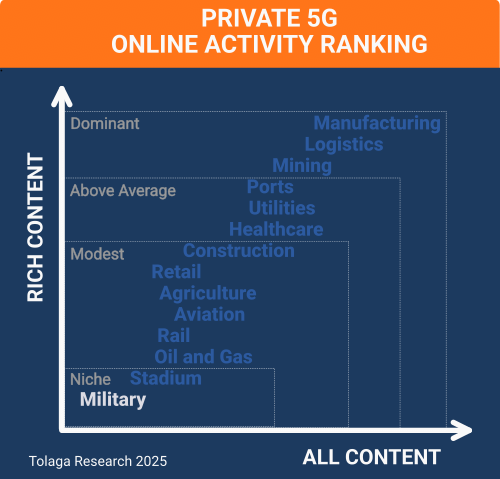
The military is a niche sector for private 5G (P5G), with our online content survey ranking the military 14th out of the 14 industries researched.
Ericsson and Nokia lead online content on P5G deployments for defense with solutions that enable mission-critical operations, real-time data exchange, and battlefield intelligence, strengthening command, control, interoperability, and situational awareness for military forces.
P5G offers promising benefits for military operations, including secure and high-speed connectivity for real-time data exchange among drones, vehicles, sensors, and command systems.
Global defense forces are piloting P5G in diverse use cases, from smart bases and secure logistics to cyber training and autonomous systems, though adoption levels vary by country.
P5G is seen as a key enabler of future military capabilities, supporting resilient command and control, automation, and mission-critical communications, often with an emphasis on Open RAN and local industry involvement.
Security and network "air-gapping" are top priorities, with many deployments utilizing local cores, robust encryption, and measured reliance on public networks.
Challenges such as spectrum access, compatibility, integration, and cost remain, and broader adoption will require continued coordination across governments, industry, and regulators.
The military is undergoing rapid digital transformation driven by technologies such as artificial intelligence, Private 5G (P5G) networks, autonomous systems, and integrated digital platforms. These innovations support secure, real-time data exchange, enable multi-domain operations, and enhance situational awareness and decision-making speed. Key priorities include adopting zero-trust cybersecurity architectures, advancing human-machine teaming, upskilling the digital workforce, and modernizing IT infrastructure. Together, these efforts are transforming warfare into a networked, data-driven model that enhances agility, resilience, and operational effectiveness.
Among the most transformative technologies are drones, which are redefining modern combat. These systems provide cost-effective, autonomous, and scalable capabilities for both reconnaissance and precision strikes, enhancing situational awareness while reducing risk to personnel. Their effectiveness relies on highly reliable wireless connectivity, supported by technologies such as P5G, which deliver the high-speed, low-latency communication essential in dynamic combat environments.
P5G networks offer the military a secure, resilient, and ultra-low-latency communications backbone that supports a wide range of mission-critical applications. On the battlefield, P5G supports real-time situational awareness by enabling rapid data exchange between drones, vehicles, sensors, and command centers, facilitating faster and more informed tactical decisions. Autonomous ground and aerial systems rely on P5G for precise remote control and navigation. On military bases, these networks support smart logistics, secure operations, and facility monitoring using connected IoT devices.
In training environments, P5G enables realistic, AR- and VR-enhanced exercises by ensuring fast, and synchronized content delivery across distributed participants. Advanced features such as network slicing allow critical communications to receive priority, ensuring consistent performance even under heavy network demand. Meanwhile, military-grade encryption and access controls protect sensitive data from cyber threats.
Ultimately, P5G equips defense forces with an adaptable, future-ready communications infrastructure, which is crucial for maintaining operational effectiveness and interoperability, as well as responding rapidly to evolving threats and technological advancements.
Online content published since 2022 that related to P5G for the military was collected and filtered using proprietary web crawling, AI, and NLP tools, yielding a corpus of 34 relevant impressions (ALL CONTENT). Of this, 22 focused on company activity in the sector (RICH CONTENT), identifying 44 companies. Approximately 6.0 % of the content in the corpus referenced multiple industry verticals in addition to manufacturing, with an average of 2 other industries mentioned in this content.
The chart compares the content corpus for P5G for the military against other industry verticals to gauge relative market momentum. The analysis indicates that the military is currently a niche vertical market segment for P5G.
Natural language processing (NLP) and AI tools were used to identify companies mentioned in the content corpus, measure their prevalence (BREADTH), and evaluate how frequently they appear alongside other companies (DEPTH). For the 44 companies identified, the ranking of the top 10 is shown in the chart below.
Ericsson is advancing P5G for defense with solutions that support mission-critical operations, enhanced communications, and emerging military applications. Its efforts include building P5G networks for bases in partnership with global operators, enabling real-time data exchange, predictive maintenance, and asset tracking, while also supporting secure communications, rapid deployment, and interoperability with NATO and allied forces.
Nokia is providing P5G solutions for defense through secure, high-performance, and portable tactical networks that enable real-time battlefield intelligence, advanced communications, and faster decision-making. Its offerings, such as the rugged Banshee 5G Tactical Radio and Mission-Safe Phone, strengthen command and control, improve situational awareness, and ensure resilient, scalable connectivity for defence forces in demanding mission environments.
NLP and AI techniques were used to identify and classify keywords and phrases in the content corpus into 25 topics. Their frequency was measured (BREADTH) and their inter-relationships analyzed (DEPTH). The chart below shows the top 10 topics.
The most prominent topics in online content today are compute and communications, command and control, remote operations, and artificial intelligence. Over time, we expect themes specific to the Air Force, Army, and Navy to increase in prominence.
Military forces worldwide are trialing P5G to enable secure, high-speed communications for command, control, logistics, and autonomous systems. NATO, the EU, and nations including the U.S., China, India, and Australia are pursuing indigenous and collaborative approaches, while projects like 5G.MIL and 5G-MILNET are driving collaborative innovation initiatives. While P5G offers resilient, mission-critical connectivity, it faces challenges with spectrum allocation, interoperability, legacy integration, and cost.
Many military forces are actively evaluating and trialing P5G technology to support a wide range of mission-critical operations. Countries such as India and Turkey are also promoting domestically developed P5G solutions that leverage standards like Open RAN, aiming to reduce reliance on foreign supply chains for defense communications infrastructure.
While much of the military-related activity around P5G remains outside the public domain, several defence organisations have disclosed select initiatives. In parallel, multinational efforts, led by entities such as the European Union and NATO, are advancing collaborative approaches to P5G adoption, interoperability, and standardization.
NATO is actively advancing P5G networks to enhance secure, high-speed, and flexible communication across allied forces. Through initiatives such as the Digital Backbone Experimentation 2024 and the Joint Viking 2025 exercise, NATO is testing the integration of commercial 5G infrastructure with secure, private networks to support mission-critical functions, including command and control, intelligence gathering, UAV operations, smart logistics, and IoT-enabled systems. The alliance emphasizes interoperability among member states and excludes untrusted foreign technology to ensure cybersecurity and operational resilience. NATO’s approach blends commercial capabilities with bespoke P5G systems to enable real-time battlefield data sharing and rapid deployment, positioning P5G as a foundational element of its broader European defense modernization strategy.
Complementing these efforts, the NATO-led Multinational Collaboration on 5G (MN5G) was launched in October 2024 by Italy, Spain, and Turkey, under the auspices of the NATO Communications and Information Agency (NCIA). The initiative aims to advance secure, interoperable, and spectrum-efficient 5G capabilities tailored to multinational defense use. MN5G promotes information sharing, aligns military-specific requirements, and standardizes to ensure that future 5G technologies meet defense needs. The project also coordinates research, development, and experimentation at both national and NATO levels, engaging industry and academia to accelerate innovation and build resilient 5G systems for joint military operations.
5G.MIL is a network architecture developed by Lockheed Martin between 2021 and 2025, aiming to integrate advanced 5G technologies with existing military communications systems to support secure, resilient, and interoperable connectivity across various domains, including air, land, sea, space, and cyber. The network was developed in collaboration with companies including AT&T, AccelerComm, Intel, Nokia, Radisys, and Verizon. It is designed as a heterogeneous “network of networks,” incorporating open systems architecture, tactical gateways, and commercial 5G advancements to enable data flow, edge processing, and mission-relevant communications—even in challenging or contested environments. The approach is designed to support emerging capabilities, such as autonomous systems and artificial intelligence, and enhance situational awareness, command and control, and decision-making processes. Emphasis is placed on resilience, with design features to reduce single points of failure and support multi-level security. The architecture also allows for integration with legacy systems and aims to extend connectivity using both tactical and commercial infrastructure. 5G.MIL represents a potential step forward in providing flexible and robust communications support for joint military operations in increasingly digital and complex operational environments.
Launched in July 2025 in Athens, Greece, 5G-MILNET is an EU-funded collaborative project focused on developing a portable, secure, and cost-effective tactical 5G communications "bubble" for rapid deployment in battlefield environments. Designed to operate without fixed infrastructure, the system delivers high-speed, low-latency, and resilient real-time communications, enhancing situational awareness and operational agility. The project brings together partners from Cyprus, France, Germany, Greece, and Spain. Key contributors include eBOS (Cyprus), leading system architecture; Ecliptic Defence and Space (Cyprus), providing RF and electronic warfare resilience; Eurecom (France), specializing in secure communications; Pleione Energy (Greece/Germany), supplying advanced power systems; Athena Research Center (Greece), contributing ICT and AI-driven design; and Iquadrat (Spain), develop a secure portable tactical 5G systems. Collectively, these partners are building a next-generation 5G platform tailored to the demanding needs of military operations.
The Australian Defense Force (ADF) began exploring P5G and 5G-ready networks in the early 2020s, with experimental deployments and strategic initiatives accelerating around 2023–2024. By 2024, the ADF was actively deploying private LTE and 5G-capable networks to enhance wireless broadband connectivity across both live and synthetic training environments.
As an early global adopter of P5G, the ADF is leveraging the technology to improve interoperability, situational awareness, and operational command across joint task forces. P5G is also being utilized to support automation, facilitate secure communications within military installations, and enable remote operations, such as drone control. In addition, Australia’s Advanced Strategic Capabilities Accelerator (ASCA) plays a key role in advancing P5G, focusing on how it can strengthen tactical communications and joint force coordination. Its mission is to deliver rapidly deployable, secure, and mission-critical communications infrastructure that meets the ADF’s evolving operational needs.
The Belgian military has deployed P5G networks at key strategic sites, notably the Port of Antwerp and the Air Force base in Beauvechain, Walloon Brabant. At the Port of Antwerp, the P5G network supports various commercial operations, including surveillance, logistics, autonomous vehicle operations, and drone deployments. Although primarily used for civilian applications, the network is explicitly designed to accommodate mission-critical military needs when required.
At Beauvechain Air Base, the P5G deployment focuses on securing and testing mission-critical communications, aiming to match or surpass the security and reliability of the existing TETRA radio system. Key components of the 5G core network are hosted locally on base to ensure sensitive data remains within a secure military environment. This hybrid setup integrates Orange Belgium’s 5G core infrastructure with on-site equipment to enable secure voice communications and high-bandwidth applications, such as bodycams.
The deployment incorporates enhanced security measures, including additional encryption layers and extensive testing conducted jointly by the Ministry of Defence and Orange Belgium. Active deployment and validation efforts have been underway since the 2023-2024 timeframe, as part of broader government-backed 5G pilot initiatives. The result is a specialized and secure P5G environment tailored to the operational needs of the Belgian armed forces.
The Chinese military is leveraging P5G to enable the large-scale deployment of intelligent unmanned systems, including drones, robotic dogs, and other autonomous combat platforms. It has developed what is reportedly the world’s first mobile 5G base station designed for battlefield conditions, capable of serving up to 10,000 users within a 3 km radius, with latency under 15 milliseconds and highly reliable data throughput.
This mobile 5G system is engineered to maintain connectivity in complex environments such as mountainous terrain or dense urban areas where conventional ground stations or satellite signals may be degraded or unavailable. A notable innovation includes the use of drones as airborne 5G base stations, which autonomously recharge from military vehicles to ensure persistent coverage.
These capabilities support the PLA’s (People's Liberation Army) ambition to field the world’s largest unmanned military force by integrating highly autonomous robotic systems into the battlefield. The military grade 5G infrastructure also incorporates advanced countermeasures against electromagnetic interference and features automated network management for enhanced operational resilience.
The Estonian military is leveraging P5G technology to enhance cybersecurity training and bolster protection of critical infrastructure. A key initiative involves integrating a 5G standalone network at the Estonian Cyber Range, a cybersecurity training facility, enabling ultra-low latency and real-time capabilities to support realistic cyberattack simulations and the development of defensive tools. This effort is a collaboration between Nokia, Thinnect, the University of Tartu, NATO’s Cooperative Cyber Defense Centre of Excellence, and Elisa Estonia, with support from the Estonian Research Council.
In parallel, the Estonian military has partnered with Telia Estonia to test a tailored P5G solution designed to explore secure, high-reliability connectivity for defense applications. These initiatives align with broader NATO objectives to deploy resilient military 5G networks across member states.
The Finnish military is leveraging P5G to enhance defense operations, particularly in coalition and cross-border contexts. In a significant 2025 trial, the Finnish Defense Forces, in collaboration with Nokia and Telia, successfully demonstrated the world’s first seamless 5G standalone slice handover across multiple national borders during a Nordic military exercise. This breakthrough enabled continuous, secure data connectivity for personnel moving across three countries’ 5G networks, supporting mission-critical applications with high reliability and security.
The system integrates Nokia’s 5G infrastructure with Telia’s commercial network, managed through an intelligent control platform that optimizes performance. This capability is intended to support modern defense operations beyond national borders and aligns with NATO’s interoperability and communication objectives. The Finnish Defense Forces also plan to expand their use of hybrid 5G solutions, combining commercial and field networks to enhance command, control, and operational readiness in dynamic environments.
The German military is actively deploying P5G networks to support research, testing, and the development of advanced digital applications tailored to defense needs. A prominent example is the 5G standalone campus network established at the University of the Federal Armed Forces in Hamburg, implemented by Deutsche Telekom in partnership with Ericsson. This dedicated P5G network enables research into industrial and military applications, including real-time sensor networking, cyber-physical systems, automation technology, logistics, autonomous robotics, drone defense systems, and 5G-based safety and security solutions.
Operating independently of public mobile networks on reserved spectrum, the network offers advanced capabilities, including network slicing and ultra-low latency. It serves as a modern testbed that bridges academic research with practical military innovation.
In parallel, Nokia and Blackned GmbH are collaborating to develop deployable tactical 5G systems for battlefield use. These mobile, secure networks are designed to support command, control, and situational awareness in dynamic operational environments, aligning with Germany’s defense requirements.
Germany also contributes to the EU-funded 5G-MILNET project through Pleione Energy GmbH, a German-Greek joint venture specializing in advanced power solutions for military-grade 5G deployments.
The Greek military is actively advancing P5G network capabilities through the newly launched 5G-MILNET project. As of early 2025, it has issued calls for the development of advanced, modular 5G wireless communication systems tailored explicitly for military applications. These initiatives form part of broader defense modernization efforts under Greece's "Agenda 2030" reform program, announced in July 2025.
The Indian military is actively exploring the integration of private and indigenous 5G technologies to modernize battlefield communications, improve operational effectiveness, and bolster resilience against cyber and electronic warfare threats. Key initiatives include the establishment of defense-oriented 5G testbeds, most notably at the Military College of Telecommunication Engineering in collaboration with IIT Madras, and the development of military-grade 5G and emerging 6G applications to support secure, real-time, and network-centric operations.
The Indian Army seeks to leverage 5G for frontline communications, drone operations, intelligent surveillance, and AI-enabled decision support. These efforts align with the Atmanirbhar Bharat (“self-reliance”) initiative, emphasizing strategic autonomy through collaboration with domestic technology firms and research institutions. There is a strong focus on indigenous solutions, and recent regulatory discussions have considered allocating dedicated spectrum for defense-specific 5G deployments. Trials are ongoing across tri-service (Army, Air Force, Navy) environments and along sensitive border areas.
In January 2025, Reliance Jio announced the deployment of 5G services at a forward post on the Siachen Glacier, located at an altitude of 16,000 feet. The rollout was conducted in partnership with the Indian Army’s Fire and Fury Corps. Jio deployed a plug-and-play, pre-configured 5G base station built on its own technology. The network improves communication for personnel in this remote and challenging environment, supporting operational efficiency and border security. Jio is also extending coverage to other forward posts along the Ladakh border.
The Japanese military, particularly the Japan Self-Defense Forces (JSDF), is actively exploring and deploying P5G, known locally as "Local 5G", across select defense installations to digitize rear area operations and strengthen secure, high-speed communications. These deployments are focused on non-combat support zones, such as command centers, logistics hubs, and military bases, where P5G can enhance operational efficiency, reduce manpower burdens, and support remote surveillance and automation.
The initiative reflects Japan’s broader defense digitalization strategy, which seeks to modernize base-level infrastructure with advanced technologies. Use cases include AI-enabled security systems, automated gate control, base perimeter monitoring with smart cameras and drones, and improved internal communication systems for command staff and logistics units. By utilizing dedicated P5G networks, the JSDF aims to operate independently of commercial carriers, thereby ensuring network security, resilience, and continuity during crises or cyber incidents.
The Ministry of Defense has recognized P5G as a key enabler for the next-generation digital battlefield and is positioning these deployments as stepping-stones toward integrating more complex applications, such as cyber-physical systems, command and control (C2) modernization, and multi-domain operations support. While initial deployments are aimed at support and administrative functions, the long-term objective includes expanding P5G capabilities to forward operating environments where real-time data, autonomous systems, and resilient communications are critical.
The Latvian military is actively advancing P5G network technology, centered around the 5G military test site at Ādaži Military Base, developed in collaboration with mobile network operator LMT. The site features a fully operational 5G base station and comprehensive coverage, enabling the development and testing of next-generation military applications. These include virtual and augmented reality for medical training, support systems for unmanned aerial vehicles, and computer vision and sensor technologies developed locally in Latvia.
The testbed serves as a regional hub for NATO allies to co-develop and validate 5G-enabled defense innovations, accelerating technological advancement in secure communications and autonomous platforms, including modular unmanned ground systems. It also supports enhanced situational awareness, secure data exchange, and real-time battlefield applications, reflecting Latvia’s strategic investment in future-ready military communications and its role in NATO’s evolving digital defense ecosystem.
The Norwegian military is actively deploying and developing P5G networks in collaboration with commercial telecom providers, including Telenor Norway, Telia Norway, and Ice, as well as equipment vendors such as Ericsson, Mavenir, and Nokia, to enable reliable and secure P5G services. Telenor is collaborating with the Norwegian Defence Materiel Agency (NDMA) to establish a private, autonomous 5G network specifically designed for the Armed Forces, offering high data throughput, robust security, and independence from public infrastructure.
Telia Norway is contributing to the deployment of tactical P5G solutions using network slicing, reserving a secure, isolated portion of its commercial 5G infrastructure for military use to ensure resilient and flexible communications. In parallel, Ice, Norway’s third-largest mobile operator, provides a dedicated 5G network slice exclusively for the Armed Forces nationwide, enabling secure, low-latency, end-to-end communications.
This multi-operator strategy enables the Norwegian military to utilize civilian spectrum while maintaining the security, robustness, and rapid deployability necessary for defense operations. P5G networks are being tested in live military exercises, such as Joint Viking 2025, demonstrating enhanced battlefield intelligence, situational awareness, and communications capabilities. These efforts reflect a broader strategic initiative to integrate advanced, secure 5G communications into Norwegian defense infrastructure, combining commercial innovation with military-grade requirements for secure, resilient, and adaptable tactical networks.
Qatar's Ministry of Defense Signals Corps has deployed a nationwide P5G network as part of a long-term evolution to 5G modernization, aimed at enhancing mission-critical communications for the armed forces. This initiative provides a secure, high-performance wireless infrastructure specifically designed to meet the military's nationwide requirements. The deployment operates within a regulatory framework established by Qatar's Communications Regulatory Authority (CRA), which encourages the use of public 5G networks while also permitting entities, such as the military, to obtain spectrum licenses for dedicated, self-provisioned P5G under strict conditions. These provisions ensure robust security, reliability, and operational control for critical defense communications.
The South Korean military, specifically the Republic of Korea Navy, is actively deploying a P5G network at a naval base as part of its "Smart Naval Port" initiative. Samsung Electronics and KT Corporation have been selected to build the P5G infrastructure, which will support operations in the Navy's 2nd Fleet. Targeted for completion by December 2025, the deployment is designed to enhance both base and battleship operational support, strengthen base defense, and enable advanced applications such as digital twins, intelligent security monitoring, uncrewed vehicle operations, and automated armory and ammunition depot management. The network leverages Samsung’s P5G Standalone Compact Core and operates on mid-band spectrum (n79, 4.7 GHz), a frequency range commonly used for military applications.
The Spanish military, notably the Army and Navy, is actively deploying P5G networks as part of a broader digital modernization initiative, with total investments estimated at approximately €50 million. Between 2023 and 2024, multiple contracts totaling around $15 million USD were awarded to telecom operator Telefónica to deliver standalone 5G infrastructure tailored to military requirements.
These deployments span a wide range of applications, including brigade mobility, armored vehicle systems, helicopter maintenance facilities, naval bases, warships, and marine infantry units. The networks are designed to enhance secure communications, real-time monitoring, and operational efficiency across diverse mission-critical functions.
The Swedish military is actively advancing P5G capabilities through collaborative initiatives, such as the NorthStar program, which was developed in partnership with Telia and Ericsson. This effort focuses on secure, mission-critical communications, precise positioning, and tactical networks designed for use in environments with limited coverage. In parallel, Sweden is upgrading its national critical communications infrastructure through the Rakel G2 network, which is built on Ericsson’s 5G core, and will support public safety, emergency services, and military operations starting in 2024.
This dual strategy combines experimental, defense-specific 5G deployments with broader national modernization to deliver secure, resilient, and interoperable communication systems. These capabilities are essential for defense readiness, crisis response, and enhanced coordination with NATO allies.
Turkey is developing sovereign P5G networks for military use in parallel with its participation in NATO’s Multinational Collaboration on 5G (MN5G). Through domestic firms such as ULAK and partnerships with providers like Turkcell, Turkey is rolling out secure, Open RAN–based 4.5G and 5G infrastructure nationwide. These networks are expected to support mission-critical applications, including those for the military, which typically involve secure command and control, tactical communications, and integration with drones and smart defense systems.
This strategy aims to reduce Turkey’s reliance on foreign technology, enhance national security, and position the country as a regional leader in next-generation defense communications.
The UK military, notably the British Army, is actively deploying P5G networks as part of a broader effort to develop "smart bases." A key example is the smart base at Larkhill in Wiltshire, which combines private 5G with fiber broadband to enable advanced digital capabilities, including video analytics, sensors, facial recognition, smart building access, and digital signage. This is part of a five-year, multi-million-pound contract with BT, signed in June 2023, to deliver managed Wi-Fi services across 162 army sites nationwide.
Plans include extending P5G deployments to additional military locations, with potential expansion to Royal Navy and Royal Air Force facilities. The initiative aims to improve secure, high-performance connectivity for operations, training, welfare, and base security, while advancing the UK’s defense digital transformation agenda. The network infrastructure includes managed firewalls and smart building systems, which support energy efficiency and sustainability, essential for both operational and environmental goals.
In parallel, the UK defense industry is exploring P5G applications in secure manufacturing and advanced combat systems. For example, a collaboration between O2 (Telefónica UK) and aerospace company Leonardo focuses on developing 5G-enabled "future factory" capabilities for defense production environments.
Additional innovations are emerging from UK companies such as JET Connectivity, which is demonstrating rapidly deployable, sovereign P5G solutions for mission-critical military operations. These systems emphasize resilience, scalability, and secure communications tailored to dynamic battlefield and forward-operating conditions.
The United States military, through the Department of Defense (DoD), is actively implementing P5G networks as part of a comprehensive strategy to enhance secure, scalable, and high-performance wireless communications across military installations. The DoD has released a P5G Deployment Strategy outlining plans to develop networks tailored to mission-critical defense needs, capabilities that commercial 5G alone cannot provide, particularly for warfighters and battlefield operations.
The strategy emphasizes integrating P5G with commercial 5G infrastructure to optimize coverage, performance, and security while enabling joint force capabilities and rapid data exchange in operational environments. Open Radio Access Network (Open RAN) technologies are prioritized to support flexible, vendor-agnostic architectures. A DoD-led cross-functional team oversees governance and standardization to accelerate P5G adoption across services.
Selected military installations are piloting P5G networks to support advanced use cases, including autonomous systems, and secure tactical communications, with broader deployment planned. Where appropriate, P5G systems will interoperate with public 5G networks to ensure continuity and scalability.
In parallel, commercial partners such as Verizon are deploying private 5G networks under initiatives like the Department of the Air Force (DAF) LTE/5G Initiative, which aims to equip 84 Air Force and Space Force bases with private 5G infrastructure by 2028.
P5G networks offer significant opportunities for military applications, providing secure, dedicated communication channels that are less vulnerable to interception and cyberattacks compared to public networks. With ultra-low latency and high bandwidth, these networks enable real-time data exchange, which is crucial for maintaining battlefield awareness and making rapid decisions. This performance underpins the effective operation of advanced technologies, such as autonomous vehicles, drone swarms, and augmented reality–enhanced training, in complex, fast-moving environments.
P5G also enhances command and control by supporting seamless connectivity across dispersed units and integrated sensor systems, improving operational efficiency and mission execution.
However, deploying private 5G in military settings involves several challenges. Securing dedicated spectrum licenses can be challenging due to competition from civilian telecom operators and regulatory limitations. Integrating 5G with legacy military communications infrastructure adds complexity and requires robust interoperability and standardization to ensure systems function cohesively. The cost of building, deploying, and sustaining bespoke P5G networks is considerable, demanding careful planning and phased implementation. Additionally, maintaining end-to-end security, including trusted hardware and software supply chains, requires ongoing vigilance and technological innovation.
Addressing these challenges will require sustained collaboration among the defense community, military organizations, regulators, industry partners, and domestic technology developers. Such cooperation is essential to unlock the full potential of private 5G as a transformative enabler of future defense capabilities.
P5G networks are becoming an essential enabler of military digital modernization, providing secure, high-performance communications that support a diverse range of defense applications. These include real-time data sharing, autonomous systems, smart base operations, and immersive training environments. Across NATO, the EU, and individual defense forces, P5G is being tested and deployed to improve command and control, increase agility, and strengthen resilience in increasingly complex operational settings.
While the potential benefits are substantial, realizing them will require sustained effort and commitment. Key challenges include securing access to spectrum, ensuring compatibility with legacy systems, managing deployment costs, and maintaining trusted supply chains. P5G adoption will likely follow a phased and hybrid approach—blending bespoke military deployments with commercial infrastructure where appropriate. Continued collaboration between defense agencies, industry, and regulators will be essential to ensure P5G networks are fit for purpose, scalable, and aligned with evolving mission requirements.
