



















September 2025
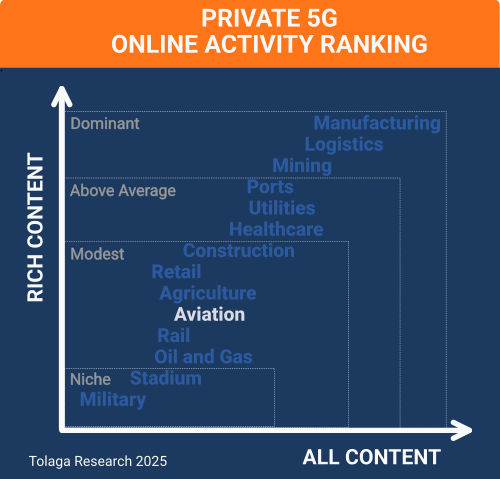
Aviation is a modest opportunity for Private 5G (P5G), with our online content survey ranking aviation 10th out of the 14 industries researched.
Ericsson is most prominent in online content relating to P5G for aviation, with networks that enable automation, predictive maintenance, and advanced airport operations at sites including Purdue, Schiphol, and Auckland airports.
Digital transformation is reshaping the aviation industry: Airports and airlines are embracing AI, IoT, cloud computing, and automation to enhance operational efficiency, safety, and passenger experiences while reducing costs and downtime.
Private 5G is a critical enabler: P5G networks offer high-speed, low-latency, and secure connectivity that outperforms Wi-Fi, supporting real-time baggage handling, maintenance, surveillance, and autonomous operations.
Adoption faces real challenges: High upfront costs, legacy system integration, skills shortages, regulatory hurdles, and the need for multi-stakeholder alignment continue to hinder large-scale P5G rollout.
Use-case-focused pilots are proving value: Airports across regions—ranging from Frankfurt and DFW to Langkawi and Sofia—are deploying P5G in targeted ways, enabling applications such as autonomous vehicles, smart surveillance, and digital twins.
Government and industry collaboration is essential: Co-funding mechanisms (e.g., EU’s CEF), strategic partnerships, and regulatory engagement are key to overcoming financial and operational barriers.
Phased deployments support scalability: Starting with high-impact use cases enables airports to demonstrate early ROI, build internal capability, and mitigate future risks associated with P5G infrastructure expansion.
Security and standards must evolve with scale: Cybersecurity and interoperability frameworks are critical for scaling P5G networks across complex aviation environments with multiple vendors and systems.
While still in the early stages of adoption, P5G has the potential to support the development of smarter, more adaptive airport infrastructure as the aviation sector gradually transitions toward more connected and data-driven operations.
The aviation industry is undergoing a significant digital transformation aimed at enhancing efficiency, safety, and the overall passenger experience. Airlines and airports are adopting AI, machine learning, big data, and IoT to improve flight operations, facilitate predictive maintenance, and support real-time analytics, ultimately reducing costs and minimizing downtime. Passenger services are becoming increasingly seamless and personalized using self-service kiosks, biometric identification, and mobile check-in. Meanwhile, cloud computing and blockchain are bolstering data security and transparency, while automation is streamlining both front- and back-end operations. While challenges such as high capital investment and cybersecurity risks persist, the industry’s shift toward data-driven decision-making is delivering measurable gains in cost-efficiency, safety, and sustainability, reshaping the future of air travel.
Private 5G (P5G) is poised to support the aviation industry’s digital transformation, offering reliable, high-speed connectivity that enables real-time baggage handling, maintenance, security, and automation, surpassing traditional Wi-Fi in busy, complex airport environments. However, widespread adoption faces significant hurdles, including high costs, complex integration with legacy systems, a shortage of in-house expertise, regulatory and spectrum challenges, heightened cybersecurity risks, and a still-maturing vendor ecosystem. While these factors can slow or complicate deployment, some aviation leaders recognize that P5G’s ability to boost automation and operational efficiency makes it a strategic asset for those willing to invest in overcoming these challenges.
Online content published since 2022 that related to P5G in aviation was collected and filtered using proprietary web crawling, AI, and NLP tools, yielding a corpus of 139 relevant impressions (ALL CONTENT). Of this, 118 focused on company activity in the sector (RICH CONTENT), identifying 95 companies. Approximately 19.0 % of the content in the corpus referenced multiple industry verticals in addition to aviation, with an average of 2 to 3 industries mentioned in this content.
The chart below compares the content corpus for P5G in aviation against other industry verticals to gauge relative market momentum. The analysis indicates that P5G has shown only modest momentum in aviation compared to other sectors.
Natural language processing (NLP) and AI tools were used to identify companies mentioned in the online content corpus, measure their prevalence (BREADTH), and evaluate how frequently they appear alongside other companies (DEPTH). Of 95 companies identified, the ranking of the top 10 is shown in the chart below.
Ericsson is actively deploying P5G networks in aviation that aim to drive operational efficiency, safety, and innovation. For example, at Purdue University Airport, Ericsson partnered with Purdue and Saab to create a “living laboratory” that supports advanced applications such as autonomous ground equipment, electric aircraft charging management, drone detection, and optimized flight operations management. Additionally, Ericsson has collaborated with Schiphol Airport on a P5G pilot as part of its “Airport 4.0” strategy, delivering dedicated, enterprise-grade connectivity that supports IoT monitoring, predictive maintenance, enhanced security, and contactless passenger services. The company also supports New Zealand’s first P5G network at Auckland Airport’s logistics warehouse, enabling the automation of drones and robots for warehouse stocktakes through real-time data communication.
NLP and AI techniques were used to identify and classify keywords and phrases in the content corpus into 14 topics. Their frequency was measured (BREADTH) and their inter-relationships analyzed (DEPTH). The chart below shows the top 10 topics.
The most prominent topics in online content currently are compute and communications, airport operations, security, and the Internet of Things (IoT). While emerging topics such as AI, data analytics, and augmented and virtual reality are likely to gain prominence, we believe the current dominant themes will continue to prevail for the foreseeable future.
P5G is being applied across a wide range of aviation use cases, spanning operations, safety, passenger services, and innovation. Key themes include autonomous vehicles for baggage handling, logistics, and apron transport; AI-powered video surveillance, perimeter monitoring, and facial recognition for security; and drone-based applications for emergency response, runway inspections, and real-time situational awareness. P5G also enables smart baggage systems, automated maintenance reporting, IoT-driven facilities management, and environmental monitoring. Emerging use cases include AR/VR-assisted maintenance, predictive maintenance with digital twins, mobile check-in kiosks, enhanced digital signage, and digital trade testbeds. Several notable examples are summarized below.
Frankfurt International Airport, one of Europe’s largest and busiest aviation hubs, serves as Germany’s primary gateway and a major global transit point for passengers and cargo. To support its digital transformation, airport operator Fraport secured a dedicated 5G spectrum license in the 3.7–3.8 GHz band from Germany’s telecom regulator, enabling the deployment of a secure, autonomous private network across more than 8 square miles of airport grounds. In partnership with NTT, Fraport launched its Private 5G (P5G) network, following initial trials in 2022 and operational rollout in 2023. The network delivers high-bandwidth, low-latency connectivity with broader and more reliable coverage than Wi-Fi, supporting real-time data collection and advanced applications such as autonomous vehicle operations on airport aprons, AI-powered security with HD video surveillance, and the use of surveillance robots and drones. It also enables enhanced data control and autonomous voice communication to streamline airport operations.
Cologne Bonn Airport (CGN), a 24-hour international airport situated between Cologne and Bonn in western Germany, serves as a key hub for low-cost carriers and cargo operations. As part of its digital transformation strategy, the airport has developed one of Europe’s largest private 5G networks, using dedicated spectrum in the 3.7–3.8 GHz band. The project began in 2021 in partnership with Airspan, Cisco, Microsoft, Nokia, and NTT. The network delivers secure, high-speed connectivity across the airport’s 1,000-hectare site. Current applications include real-time smart metering, quality inspections, and AI-powered video surveillance along the airport perimeter. Future plans aim to improve further operational efficiency, safety, and the passenger experience by enabling autonomous baggage vehicles, automated border control, and robotics.
Brussels Airport, Belgium’s main international gateway and a major European hub handling over 26 million passengers annually, launched an airport-wide P5G network in mid-2020 in partnership with Nokia and Citymesh. The network enables advanced applications such as remotely piloted drones for real-time surveillance and inspection, including beyond visual line of sight (BVLOS) operations. Future plans include the deployment of IoT devices, autonomous vehicles, mobile safety systems, and enhanced digital signage—all aimed at improving operational efficiency, safety, and innovation across the airport.
Sint-Truiden DronePort is a 30-hectare aviation business park and test center in Flanders, Belgium, focused on innovation in carbon-free, autonomous, and advanced air mobility. As part of the 5G SENSE project and in collaboration with Citymesh, a P5G network has been deployed to support a permanently stationed emergency intervention drone serving South-West Limburg. The system enables rapid drone deployment—within 90 seconds of an emergency call—and uses high-speed, low-latency connectivity to stream live, high-definition video to first responders, delivering real-time situational awareness during critical incidents. While emergency response is the most high-profile use case, the P5G infrastructure also lays the groundwork for a broader range of industrial, commercial, and research applications in drone-based operations.
San Sebastian Airport is a small regional airport in northern Spain near the French border, serving primarily domestic and select international routes. In June 2023, the airport launched a P5G pilot in partnership with Aena (airport operator), Cellnex (wireless provider), Nokia (infrastructure partner), and Inetum (systems integrator). The network supports real-time drone surveillance, environmental monitoring, and advanced airport management tools. It also delivers fast, secure connectivity to enable future applications involving IoT, AI, and augmented reality, as the airport continues its digital transformation to enhance operational efficiency.
Sofia Airport (SOF), Bulgaria’s largest and busiest international airport, is located about 10 km east of the capital. In February 2025, the airport announced the launch of its Private 5G (P5G) network—a EUR 5.9 million, 36-month project co-funded primarily by the European Union’s Connecting Europe Facility and delivered in partnership with A1 Bulgaria and WINGS ICT Solutions. Spanning 3 square miles, the network will be designed to provide nearly complete coverage across terminals, aprons, and operational zones. It will support real-time integration of IoT sensors, AI-driven analytics, and advanced video surveillance. Key objectives include reducing wait times, optimizing passenger flow, and enhancing security through intelligent traffic and perimeter monitoring. The network will also enable reliable, prioritized communication for airport personnel and emergency services during critical operations.
Zagreb Airport, Croatia’s largest and busiest international hub, is located near the capital and serves over 4 million passengers annually. Zadar Airport, on the Adriatic coast, is a growing regional hub important for tourism and seasonal flights, while Pula Airport specializes in summer charter and low-cost services catering to the Istria region’s tourist industry.
In June 2025, Hrvatski Telekom, together with infrastructure firm Markoja, the Faculty of Transport and Traffic Sciences, and the airports of Zagreb, Zadar, and Pula, proposed a EUR 5.6 million project to deploy Private 5G (P5G) networks across all three airports. The initiative, pending funding from the European Union’s Connecting Europe Facility (CEF), aims to accelerate digital transformation, operational efficiency, and the passenger experience. The proposed P5G networks would deliver secure, ultra-reliable, and low-latency connectivity for advanced use cases that exceed the capabilities of conventional Wi-Fi.
At Zagreb Airport, drones equipped with AI-powered UHD cameras will perform automated runway and perimeter inspections. Pula Airport plans to install 50 UHD cameras and sensors for real-time AI-driven intrusion and wildlife detection. Zadar Airport will deploy AI-enabled tablets to automate maintenance reporting. These innovations are expected to reduce manual oversight, accelerate inspections, improve security, and support future smart airport operations. If approved, the project would provide the airports with three years of free access to standalone (SA) 5G infrastructure, removing upfront investment barriers and enabling rapid, large-scale digitalization.
Teesside International Airport, located in Darlington, England, serves the Teesside region with passenger flights across Europe, cargo handling, and a growing business park. It plays a key role in regional economic development and is closely linked to the Tees Valley Freeport, with ongoing investment in infrastructure and sustainable aviation fuel.
In early 2025, construction of a private 5G network at the airport began, with physical works publicly confirmed by May. AWTG Ltd., a UK-based engineering services provider, was awarded the contract for installation and operation, with a formal start date of 30 June 2025. The project is valued at over USD 585,000.
The network will underpin the Teesside Digital Trade Test Bed, a secure digital zone designed to streamline trade and customs processes. It will support trials of advanced technologies, including freight scanning software, autonomous vehicles, AI/ML, IoT, geofencing, and decentralized digital identities. By simulating cross-border movement of goods and services in a controlled environment, the test bed aims to help vendors, logistics providers, and service operators develop and refine digital trade solutions. These efforts align with the UK Border Strategy by enhancing efficiency, reducing costs, and improving the speed of customs and trade operations.
Dallas Fort Worth International Airport (DFW), one of the world’s busiest airports, announced in May 2023 the deployment of a P5G network in partnership with AT&T. The five-year, $10 million investment aims to modernize connectivity for both passengers and airport operations. The network, owned and managed by DFW, will utilize the 3.5 GHz CBRS spectrum to provide secure, reliable, and low-latency coverage across terminals, parking areas, and runways.
Nokia is supplying approximately 33 CBRS transmission sites, while Cisco is upgrading Wi-Fi infrastructure to support a converged wireless platform that unifies P5G and Wi-Fi traffic under a single management system. Initial use cases include IoT-driven applications such as real-time restroom occupancy monitoring, baggage tracking, escalator and walkway maintenance alerts, concessionaire updates, remote solar-powered surveillance, and trials of autonomous shuttles. The P5G network is designed to enable future digital transformation, supporting advanced analytics, enhanced security, and operational efficiency. In addition, AT&T pays DFW an annual fee to offload a portion of its cellular traffic onto the airport’s infrastructure.
Hong Kong International Airport (HKIA) is a major global hub and the world’s busiest cargo airport, serving over 200 destinations with about 140 airlines. In 2022, the airport implemented an end-to-end standalone (SA) P5G network, which was fully deployed in mid-2022 and has been continuously expanded to support significant developments, such as the Three-Runway System, which involved the addition of a third runway and expanded terminal infrastructure to increase the airport’s capacity significantly.
Over 50 innovative applications are already live, including fleets of autonomous vehicles (electric tractors, patrol cars, and shuttle buses) that rely on real-time, high-definition video and remote control; AI-powered mobile check-in kiosks; movable digital signage with instant updates; facial recognition for staff verification; and IoT-driven baggage handling, environmental monitoring, and building integrity checks. High-resolution 4K cameras at aircraft stands stream footage directly to the Airfield Operations Centre, supporting remote marshalling and operational efficiency.
Kuala Lumpur International Airport is Malaysia’s main hub, serving over 57 million passengers annually. The airport has rolled out P5G in both its main terminal (KLIA1) and Terminal 2 (KLIA2), in a partnership between Malaysia’s state-run 5G provider, Digital Nasional Berhad (DNB), and the national digital infrastructure provider, Edotco Group. The deployment was completed in early 2025 and includes 52 in-building 5G access points and nine outdoor 5G poles, providing coverage throughout the 36-square-mile airport complex. In addition to providing coverage to passengers throughout the airport complex, the P5G network also supports enhanced airport operations capabilities with use cases that support real-time smart baggage handling and autonomous airport vehicles. The airport deployment aligns with DNB’s broader strategy for driving Malaysia’s digital and economic agenda.
Langkawi International Airport, a mid-sized Malaysian airport located on the island of Langkawi, primarily serves holidaymakers through domestic and international charter flights, functioning as a key tourism gateway for the region. In January 2020, the airport launched P5G network using both 3.5 GHz (C-band) and 70 GHz (mmWave) spectrum in partnership with Edotco Group and U.S.-based Peatalk Corporation. Designed as a reference model for future P5G deployments, the network enabled four initial smart airport use cases: trolley asset tracking, real-time air quality monitoring, facial recognition for enhanced security, and high-performance wireless connectivity that surpassed the capabilities of traditional Wi-Fi.
Auckland Airport is New Zealand’s largest and busiest airport, serving as the country’s main international gateway and handling over 18.7 million passengers in 2024. In May 2025, Spark, in collaboration with Air New Zealand, Ericsson, and Cypher Robotics, deployed a private 5G (P5G) network within Air New Zealand’s 5,000m² logistics warehouse. Purpose-built for industrial environments where traditional Wi-Fi struggles due to high shelving and complex layouts, the P5G system delivers secure, high-speed, low-latency connectivity. The network powers a fleet of automated solutions, including a tethered drone that performs barcode-based inventory counts and transmits real-time data to operational systems. This automation enables daily stocktakes, significantly improving inventory accuracy and replacing time-consuming, labor-intensive, and sometimes hazardous manual processes. Looking ahead, the P5G infrastructure will support additional applications, such as AI-enabled safety cameras and digital twin simulations for predictive maintenance and warehouse optimization.
Purdue University Airport deployed a P5G network as part of a collaboration between Purdue Research Foundation, Ericsson, and Saab in March 2023. Installed under the university’s “Lab to Life” testbed initiative, the network uses CBRS spectrum with dual-mode 4G/5G capability, supporting real-time, high-bandwidth applications. It enables advanced airport management technologies such as Saab’s Aerobahn for flight and ramp operations, SAFE for event and security management, and ADS-B sensors for live aircraft tracking. This infrastructure provides a platform for testing and deploying next-generation aviation solutions, enhancing operational efficiency, safety, and data-driven decision-making in a live airport environment.
Lufthansa Technik has deployed a P5G campus network at its Hamburg maintenance facilities. Launched in partnership with Nokia and Lufthansa Industry Solutions, the network operates on dedicated 3.7–3.8 GHz spectrum and supports advanced use cases, including virtual table inspections, remote borescope examinations, and augmented reality applications for cabin outfitting. These capabilities enable real-time, high-resolution video streaming and data transmission, allowing customers to remotely participate in maintenance decisions and technicians to improve efficiency and precision in complex operations. The deployment enhances turnaround times, reduces travel requirements, and lays the groundwork for future digital MRO (Maintenance, Repair, and Overhaul) innovations.
Private 5G adoption in aviation faces several challenges, including high deployment costs, technical complexity, signal propagation issues, skills shortages, integration with legacy systems, regulatory barriers, and the difficulty of demonstrating clear returns on investment. The need for coordination among multiple stakeholders further compounds these obstacles.
Despite these hurdles, airports are making progress through strategic partnerships with experienced technology providers, phased deployments focused on specific use cases, and collaboration with governments and industry bodies to lower costs and secure spectrum access. Additional enablers include investing in workforce training, engaging early with regulators, contributing to standards development, and implementing strong cybersecurity frameworks. By taking a pragmatic, step-by-step approach—beginning with high-impact applications—airports can build internal capabilities, demonstrate early success, and establish a foundation for scaling 5G across critical aviation operations.
Private 5G is emerging as a strategic enabler of digital transformation in aviation, offering the secure, high-speed, and low-latency connectivity needed to support next-generation airport operations. From real-time baggage tracking and AI-driven video surveillance to autonomous vehicles and digital twins, P5G is unlocking new levels of efficiency, safety, and passenger experience that surpass the capabilities of traditional Wi-Fi networks. As demonstrated by early adopters across Europe, Asia, and North America, P5G is already being deployed in diverse airport environments—from major global hubs like Hong Kong and Dallas Fort Worth to regional gateways such as San Sebastian and Langkawi.
While adoption remains uneven due to technical, financial, and regulatory barriers, the path forward is increasingly evident. Successful deployments are being driven by cross-sector collaboration, government co-funding, and a focus on targeted, high-impact use cases that deliver measurable operational benefits. By embracing phased rollouts, investing in workforce readiness, and aligning with evolving standards and cybersecurity best practices, airports can mitigate risk and accelerate time-to-value.
