














In February 2026, Tolaga will run a web-based survey on digital twin adoption across 15 industries, exploring: Contact Us: tellusmore@tolaga.comUpcoming Research
Publish Date: November 2025
Author: Phil Marshall, PhD
Digital twins extend traditional simulations by connecting models to real-time data, enabling continuous monitoring, faster diagnosis, predictive maintenance, and more informed operational decisions. The market is growing rapidly, reaching approximately USD 25.5B in 2025, with an expected annual growth rate of 18-25% through 2030, driven by digital transformation and the increasing use of AI. Adoption is strongest in industries where performance and reliability directly impact cost and outcomes, such as manufacturing, energy, aerospace, automotive, transport, and smart buildings.
However, realizing value requires clear use cases, high-quality data integration, and skilled teams; without these, digital twins risk becoming overly complicated or misapplied. Organizations should start small, focus on the most critical system elements, ensure live data connectivity, and build internal capability over time. Tolaga will conduct a survey of digital twin adoption across 15 industries in January 2025 to assess maturity, priorities, and leadership.
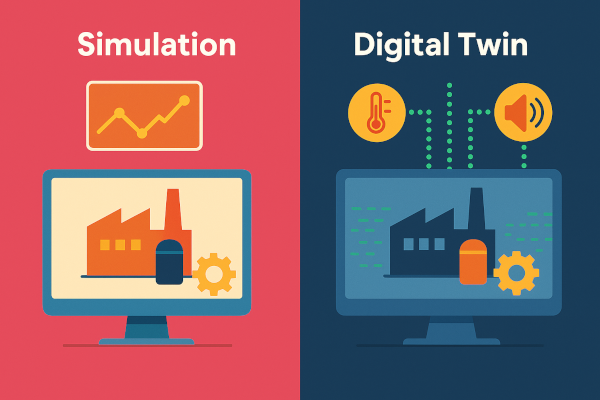
Digital twins evolved from traditional simulation models, which were initially used to test how systems might behave under changing conditions. The key difference is that simulations are typically run at a single point in time and focus on hypothetical scenarios, whereas a digital twin stays continuously connected to real data from sensors, equipment, and operational systems. In other words, a digital twin is a simulation that operates continuously using real-time data. It reflects what is happening in real-time, helps diagnose issues, and supports informed decisions and performance optimization.
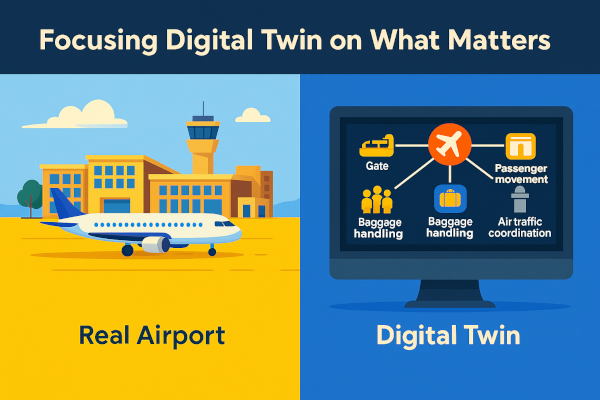
When building a digital twin, it is essential to select which aspects of the physical system really matter. No digital twin can (or should) capture every detail of the real world. Instead, it focuses on the features that support the intended goals, such as enhancing performance, increasing reliability, or reducing cost and risk. For example, a digital twin of an airport would not attempt to model every person or structure. It would focus on operational elements like aircraft scheduling, gate allocation, passenger movement, baggage handling, fuel logistics, and air traffic coordination. By focusing on what matters most, a digital twin remains functional, manageable, and capable of evolving.
This selective approach can also create confusion because digital twins are not perfect replicas; the term is sometimes used too loosely to describe dashboards, visualizations, or isolated models. If a model is not connected to real-time data or does not help guide operational decisions, it is not functioning as a true digital twin. Without clear definitions and expectations, the term risks becoming a buzzword. To avoid this, organisations need to be deliberate about the purpose of the digital twin, the problems it will solve, and how its performance will be validated in the real world.
The value of digital twins lies in their ability to monitor and improve real-world systems in real-time. By combining sensor data, operational workflows, and predictive models, organizations gain a clear view of what is happening now and what might happen next. They can experiment with changes in the digital environment before committing to them in a physical system. This leads to better decisions, reduced downtime, higher efficiency, and stronger long-term planning. Digital twins can be applied to equipment, buildings, industrial plants, transportation networks, and other systems, wherever continuous improvement is a priority.
The digital twin market encompasses software platforms, analytics tools, and modeling software, supported by implementation services, consulting, and ongoing managed services. Today, software accounts for roughly 60- 65% of total spending, and services account for the remaining 35-40%, though the balance varies depending on the level of customization required.
Digital twins come in several forms, ranging from component or asset-level twins to process twins and full system-level twins.
We estimate that the global spending on Digital Twins will increase from USD 25.58 billion in 2025 with a compound annual growth rate (CAGR) of 22.5% to USD 70.4 billion in 2030. Digital transformation programs are driving this growth, with tangible benefits for key capabilities, such as predictive maintenance and real-time operational visibility, as well as the natural alignment of digital twins with artificial intelligence. The main challenges are data integration complexity, inconsistent data quality, skills shortages, unclear ROI in some cases, and confusion about what is and isn’t a digital twin.
Our current forecast for the Digital Twins market reflects our best assessment of the current most likely trajectory, drawing on known market activity, anticipated expansion, and historical precedents from comparable adoption scenarios. As the market develops and becomes better understood, these assumptions may evolve. Sensitivity analysis is crucial when business models and business results depend on forecast outcomes, particularly when longer-term horizons (e.g., 10 years) are required for financial modeling and investment decisions. The sensitivity of the Digital Twin forecast is illustrated below with the 2025 market size ranging from $20.0 to $30.0 billion, with five- or ten-year CAGRs between 15% and 30%. Additionally, multiple adoption profiles are used to illustrate the impact of different annual growth rates across the forecast horizon.
Select Forecast Profile:
20%
25.0 bUSD

Digital twins are gaining the most traction in industries with complex physical systems where performance, reliability, and efficiency have a big financial impact. Manufacturing and industrial automation are leading users, applying digital twins to optimize production and reduce downtime. Energy and utilities use them to monitor and manage turbines, grids, and renewable assets. Aerospace, defense, automotive, and transport sectors apply digital twins across the design, test, and operations lifecycle. Adoption is also growing in smart buildings and cities, where digital twins help improve energy use, maintenance, and space planning.
In all of these sectors, the goal is the same: better decisions, less waste, fewer failures, and more reliable performance.
In January 2026, Tolaga will run a web-based survey on digital twin adoption across 15 industries, exploring: Contact Us: tellusmore@tolaga.comUpcoming Research