













The transition from 5G to 6G marks a shift toward networks that integrate communication, sensing, computing, and intelligence, and organizations now face a strategic choice between helping shape this next generation or preparing to adopt it once it is developed and matures.
The evolution of mobile networks is commonly framed as a progression through successive generations, or “G’s.” 2G marked the first significant breakthrough, standardizing digital mobile voice and introducing narrowband data through technologies such as GSM, GPRS, TDMA, CDPD, and CDMA. 3G emerged during the dot-com boom with the promise of mobile internet and rich multimedia services, but it fell short of expectations. Many operators, particularly in Western Europe, took on substantial debt to acquire 3G spectrum at the height of market exuberance, which constrained industry growth in the years that followed. The true mobile internet era did not fully take shape until the 2010s, with the arrival of 4G. This technology combined high-performance radio technologies with the widespread adoption of capacitive multi-touch smartphones, popularized by the iPhone introduced in 2007 on AT&T’s 2.5G EDGE network.
5G, first commercialized in South Korea in 2019, builds on 4G by introducing faster radio interfaces and opening access to new spectrum bands. While it has improved network performance and enabled broader industrial applications, its impact has been more evolutionary than transformational. Many deployments have continued to rely on 4G core networks in non standalone configurations, and private 5G adoption has progressed more slowly than anticipated, limiting the full realization of 5G capabilities. A familiar pattern is emerging: the even G generations, such as 2G and 4G, have historically driven the most substantial industry shifts. 6G, now in the early stages of global standardization, may become the next major inflection point.
6G is envisioned to enable a deep fusion of physical and digital worlds through ultra-fast, intelligent, and highly adaptive connectivity. Building on the foundations of 5G and 5G Advanced, 6G aims to deliver terabit-class data rates, sub-millisecond latency, and pervasive AI-driven network automation, as well as seamless integration across terrestrial, aerial, maritime, and satellite systems. It is expected to support advanced capabilities such as immersive extended reality, real-time digital twins, autonomous systems at scale, integrated communication and sensing, and highly energy-efficient massive IoT. While commercial deployment is targeted around 2030, global standardization efforts are already underway, guided by the ITU IMT 2030 framework and the 3GPP Release 19 and Release 20 work programs.
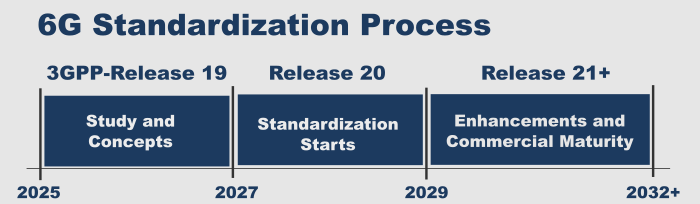
3GPP Release 19 serves as the foundational study phase for 6G, bridging the maturation of 5G Advanced with the development of next-generation mobile systems aligned with IMT 2030. Rather than defining full 6G specifications, Release 19 evaluates candidate technologies, refines initial use case requirements, and assesses system-level feasibility for capabilities such as AI native RAN and core networks, integrated sensing and communication, new spectrum ranges including sub-terahertz bands, non-terrestrial network (NTN) integration, extreme energy efficiency, and future massive MIMO and waveform evolutions. The resulting technical studies will guide the normative specification work in Release 20.
Release 20 is expected to define the first foundational specifications for 6G. It aims to expand the role of mobile networks from high-performance connectivity to a fully integrated communication and computing fabric. Expected capabilities include native AI and machine learning in the RAN, integrated sensing and communication, sub-terahertz spectrum utilization, enhanced positioning accuracy, and broader support for distributed edge computing. Release 20 will also address large-scale device interactions, ultra-high reliability, and new architectures designed for autonomous and intelligent systems. As the first release aligned directly with 6G objectives, it will set the direction for investment and ecosystem development through the late 2020s.
Release 21 and subsequent releases will continue shaping the core of 6G by refining and extending these capabilities. The focus will shift from initial design to practical operation, ecosystem integration, and large-scale commercial deployment. Advancements are expected in AI-driven network optimization, deeper convergence of communication and sensing, expanded use of sub terahertz and optical spectrum, and more efficient architectures for edge and cloud integration. Releases beyond 21 will also emphasize sustainability, energy efficiency, and dependable performance for autonomous systems across industry, transportation, healthcare, and immersive digital environments. In this phase, standards development will transition from research alignment to implementation readiness, ensuring that 6G integrates seamlessly into real world networks and applications.
The evolution of mobile networks reflects a pattern of stepwise advancement punctuated by periods of disruptive change. While 5G continues to mature, the shift toward 6G represents a broader transformation in how networks will operate, integrating communication, sensing, computing, and intelligence into a unified fabric. Early engagement in standards development, spectrum planning, research partnerships, and architectural modernization will be essential to ensure that organizations are prepared to capture the opportunities enabled by 6G. Those that act now will be better positioned to shape outcomes, accelerate innovation, and lead in the next generation of digital infrastructure.